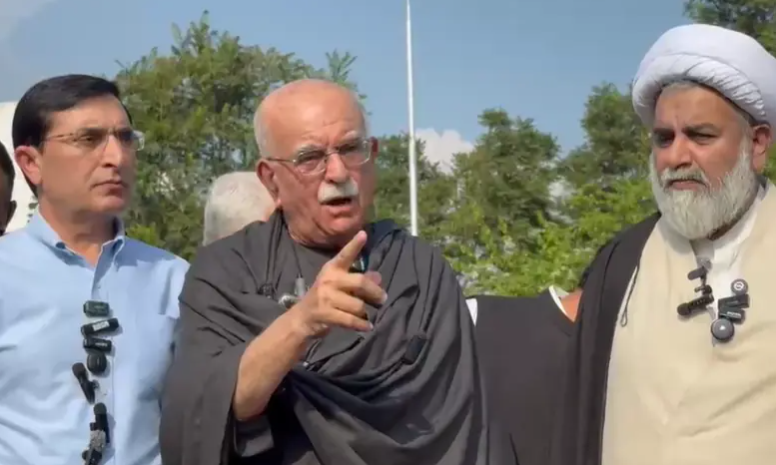
Pashtunkhwa Milli Awami Party (PkMAP) chief Mahmood Khan Achakzai has criticised the federal government’s decision to impose governor’s rule and an emergency in Khyber Pakhtunkhwa (KP), drawing comparisons with the security situation in Balochistan and calling on opposition parties to launch a democratic campaign against the move.
The federal government imposed an emergency in 12 districts of KP and introduced governor’s rule on Sunday, citing what it described as the provincial government’s deliberate disengagement from efforts to combat terrorism.
Prime Minister Shehbaz Sharif chaired the federal cabinet meeting that approved the decision. He expressed concern over the loss of civilian lives, including those of police personnel, security officials, women and children, in terrorist incidents in KP and Balochistan.
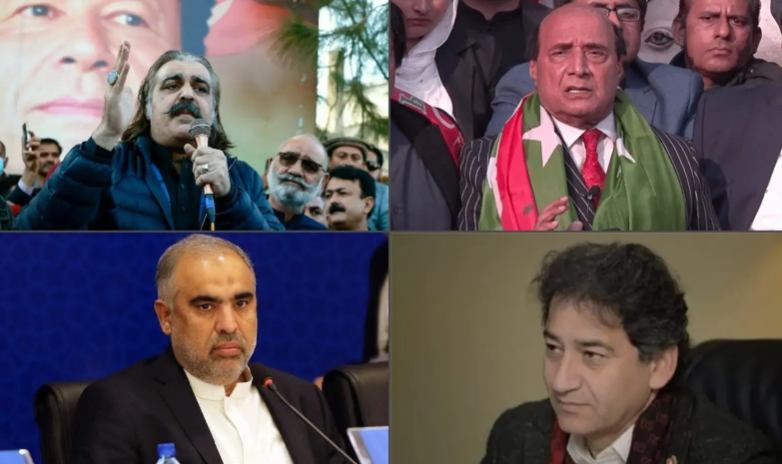
Speaking to reporters outside Parliament House on Monday, Achakzai questioned the federal government’s decision, alleging that the state’s authority was absent in large parts of Balochistan but governor’s rule had not been imposed there because the provincial chief minister was favoured by the Centre.
His remarks referred to the province’s ongoing security challenges. Both KP and Balochistan have experienced persistent militant violence. According to data compiled by the Pakistan Institute for Conflict and Security Studies (PICSS), Pakistan recorded 199 terrorist attacks in August, including 54 in KP, excluding the merged districts, and 89 in Balochistan.
Senate Opposition Leader Raja Abbas Nasir, who spoke alongside Achakzai, also questioned why emergency measures had not been introduced in Balochistan first if security concerns were the primary justification.
Nasir criticised the federal government’s October 11 decision, accusing it of undermining constitutional and democratic principles. He also challenged the legitimacy of the government, referring to allegations surrounding the 2024 general elections and subsequent political developments.
Achakzai described the imposition of governor’s rule as an assault on the Constitution and democratic institutions, urging political parties and other stakeholders to unite against the decision.
He said opposition parties would be asked to begin a democratic struggle from Tuesday in areas where they had political influence. He emphasised that the campaign would remain peaceful and would not involve violence or attacks on individuals.
The opposition leader also defended suspended KP Chief Minister Sohail Afridi, saying his efforts to organise a march to Islamabad were aimed at securing access to imprisoned former prime minister Imran Khan and obtaining medical treatment for him.
Achakzai reiterated the demand for access to Khan, assuring that opposition representatives would not disclose details of their conversations with him if meetings were permitted. They would only inform the public about his health, he said.
He added that the opposition remained open to negotiations with the federal government while continuing its political campaign against the existing system.
Achakzai also invited political parties to participate in a proposed all-parties conference to discuss the country’s governance and political future. He said he was willing to meet government representatives at a private residence but had ruled out meetings at the Prime Minister’s House, the Prime Minister’s Office or the National Assembly speaker’s chamber.
Pakistan Tehreek-e-Insaf (PTI) Chairman Barrister Gohar Ali Khan announced that the party would challenge the imposition of emergency and governor’s rule in KP before the Peshawar High Court on Tuesday.
He said a parliamentary party meeting would also determine the strategy for protests inside Parliament.
Gohar maintained that the PTI would continue raising its objections through legal and parliamentary forums, adding that the party would not accept the federal government’s decision.
He described October 11 as a dark day in Pakistan’s democratic history and said the party’s protest campaign would continue.
In a separate statement, PTI Central Information Secretary Sheikh Waqas Akram criticised the Pakistan Muslim League-Nawaz (PML-N) and the Pakistan Peoples Party (PPP), accusing them of supporting measures that he described as unconstitutional and undemocratic.
Akram said the PTI and the people of KP would oppose the removal of the elected provincial government through legal proceedings, parliamentary action and peaceful public mobilisation.
He cited several historical instances of governor’s rule and provincial government dismissals, including the removal of the Balochistan government led by Sardar Attaullah Mengal in 1973, governor’s rule in the then North-West Frontier Province in 1994, its imposition in Punjab in 2009 and the removal of the Balochistan government led by Nawab Aslam Raisani in 2013.
Akram also criticised the PML-N over its political record, referring to the 1997 attack on the Supreme Court, the emergency imposed in 1998, disputes over the results of the February 2024 general elections, reserved seats and subsequent constitutional amendments.
He urged political leaders to learn from the events of 1971, arguing that the failure to respect electoral outcomes and political representation had contributed to the country’s breakup.
Akram said national unity depended on constitutional governance, respect for voters’ choices and meaningful provincial autonomy. He added that counterterrorism efforts required coordinated national action rather than political confrontation.
Referring to figures attributed to the Centre for Research and Security Studies (CRSS), he claimed that fatalities involving security personnel and civilians in KP had declined by 16 per cent during the first nine months of 2026, while nationwide fatalities had increased by 9 per cent. He called for a transparent review of the figures and the effectiveness of security policies.
The PTI demanded the withdrawal of emergency measures and governor’s rule, restoration of the elected provincial government and dialogue to resolve the political crisis.
Separately, the Khyber Pakhtunkhwa Bar Council expressed concern over the imposition of emergency and governor’s rule, announcing a strike in court proceedings on Tuesday.
In a statement issued on Monday, the council alleged that the federal government’s decision was politically motivated and aimed at removing the provincial government over political differences.
The council stressed that such extraordinary measures must comply with constitutional provisions and prescribed legal procedures. It also raised concerns about provincial autonomy and the potential use of federal authority for political purposes.
The legal body said lawyers would play an active role in efforts to restore democratic governance and would not remain passive observers.
It announced an emergency meeting for October 17 to determine its future course of action and called for the immediate reopening of roads to restore routine activities across the province.