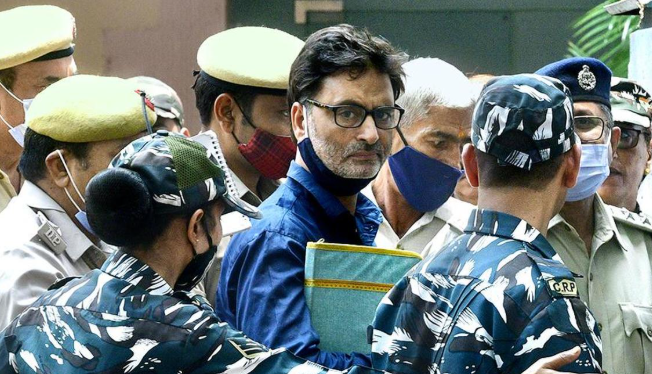
The Jammu and Kashmir Liberation Front (JKLF) has rejected allegations linking its chairman, Yasin Malik, to the 1990 killing of Kashmiri Pandit woman Sarla Bhat, after India’s State Investigation Agency (SIA) named him among five people accused in the case in June.
In a statement issued by its central information office, the JKLF leadership expressed concern over Malik’s implication in the case following an emergency consultative meeting of senior party officials.
The meeting was convened after Malik submitted a 25-page affidavit to an additional sessions court in Srinagar from Delhi’s Tihar Jail.
According to Indian media reports, Malik stated in the affidavit that he had decided not to contest the trial further. However, he said the decision should not be considered an admission of guilt or an acceptance of the prosecution’s allegations. He also asked the court to award him capital punishment and announced his decision to end his marriage.
The JKLF leadership confirmed the authenticity of the affidavit and said it supported Malik’s position. The party maintained that the details he provided regarding the murder case and the 1990 exodus of Kashmiri Pandits from Kashmir were truthful.
The organisation rejected allegations by Indian investigative agencies linking Malik to Bhat’s killing and said it would intensify its international “Save Yasin Malik” and “Justice for Yasin Malik” campaigns.
The JKLF also appealed to international leaders and human rights organisations to intervene for Malik’s release, alleging that he was being targeted by the Indian government because of his political views.
The party expressed sympathy with Malik’s wife and daughter over what it described as the difficult decisions mentioned in his affidavit, citing his prolonged imprisonment and concerns over his safety.
The JKLF reiterated its stated commitment to pursuing a peaceful resolution of the Kashmir dispute based on the aspirations of the people of Jammu and Kashmir and their right to self-determination.
In July, the organisation had also rejected the Indian government’s decision to implicate Malik, maintaining that neither he nor the JKLF had any connection with the case.
The case dates back to 1990, when Sarla Bhat was killed. In 2017, India’s Supreme Court declined to reopen several Kashmiri Pandit murder cases, citing the passage of nearly three decades and difficulties in securing reliable evidence and witnesses.
In 2023, Kashmiri Pandit groups approached Indian authorities in occupied Kashmir over unresolved killings from the 1990s. Lieutenant Governor Manoj Sinha subsequently directed police to compile a list of such cases. The Sarla Bhat case was transferred to the SIA in March 2024 for a fresh investigation.
Meanwhile, Hurriyat leader Mirwaiz Umar Farooq described developments surrounding Malik’s affidavit as concerning, particularly his decision not to contest the case further.
Farooq called for reflection on the commitments made to Malik and stressed the importance of due process, fairness and a humane approach.
He also said in a post on X that Indian authorities had placed him under house arrest on Friday, preventing him from presiding over an event at Srinagar’s Jama Masjid linked to Rabiul Awwal.
According to Farooq, the event was also scheduled to mark the release of a Kashmiri translation of the Holy Quran by Gulzar Ahmad Parray and honour a young scholar for memorising Sahih al-Bukhari.
Farooq said the restrictions would not prevent him from carrying out what he described as his responsibilities or from raising the concerns of the people of Kashmir.