The history of Turkiye’s relationship with the Arab world is deeply rooted in the legacy of the Ottoman Empire, which expanded from Anatolia across parts of Europe, the Middle East, North Africa and the Arabian Peninsula.
The Ottoman Empire’s influence also extended to key strategic waterways. Ottoman control of the Black Sea and the Dardanelles, along with the expansion of its influence across the Mediterranean, gave the empire significant geopolitical importance. The Ottomans also controlled the Crimean Khanate as a vassal state.
The empire’s rule encompassed several cities of major religious and imperial significance, including Makkah, Madinah, Jerusalem and Constantinople, now Istanbul.
Following the establishment of the Turkish Republic, Mustafa Kemal Ataturk pursued a policy of Europeanisation. The approach was also shaped by strained relations with Arab communities following the Arab Revolt during the First World War, when Sharif Hussein bin Ali of Makkah led a revolt against Ottoman rule with British support.
Turkiye was also among the countries that recognised Israel relatively early. However, relations between Ankara and Israel have changed significantly in recent years, particularly under President Recep Tayyip Erdogan, who has taken a strongly critical position on Israel’s military campaign in Gaza.
After Ataturk’s death, sections of Turkish society and the political establishment increasingly questioned the emphasis on Europeanisation. The issue eventually became a major political fault line. In 1960, the military overthrew the civilian government and later executed Prime Minister Adnan Menderes following a controversial trial.
Turkiye’s political trajectory changed significantly with Erdogan’s rise. After entering politics and serving as prime minister from 2003, Erdogan became president in 2014 and has since pursued a more assertive foreign policy, including stronger engagement with Muslim-majority countries.
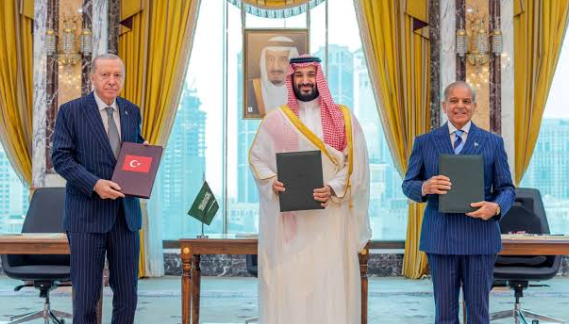
The latest development is Ankara’s decision to enter a trilateral defence relationship with Saudi Arabia and Pakistan. Under the Makkah Defence Alliance, an armed attack against any one of the three countries would be treated as an attack against all three.
The agreement represents a notable shift, particularly for Saudi Arabia, which has traditionally relied heavily on US security guarantees and avoided formal defence commitments of this nature.
Riyadh has in recent years sought to project a more diversified international image through investments in culture, entertainment and global sporting events. The new defence pact, however, adds another dimension to Saudi Arabia’s international profile by highlighting its role as a regional military power.
The agreement has also been viewed in the context of changing regional security dynamics, including tensions involving the United States and Iran. Its practical implications, however, remain subject to questions about how the mutual-defence commitment would operate in a real conflict.
For Pakistan, the arrangement also has a strategic dimension. Its longstanding rivalry with India remains a major security concern, while Islamabad’s close relationship with China is an important factor in the regional balance. The conflict between Pakistan and India in May 2025 also demonstrated the wider geopolitical calculations surrounding the two countries.
Turkiye, meanwhile, is a member of Nato, meaning any major military confrontation involving Ankara could have implications extending beyond the three countries in the pact.
The alliance is officially described as defensive and based on Article 51 of the UN Charter, which recognises the right of states to individual and collective self-defence.
For Saudi Arabia, the agreement may also reflect longstanding concerns about the reliability of external security guarantees, particularly in relation to Iran. Recent Iranian missile attacks on US military facilities in Saudi Arabia have further highlighted the kingdom’s security vulnerabilities.
The pact nevertheless raises several complex questions. One concerns the extent to which the three countries would be expected to support each other during a major conflict. Another relates to Pakistan’s nuclear capabilities and whether the security of its strategic assets could become a matter of concern for its two partners.
The agreement therefore represents more than a conventional defence arrangement. It reflects the growing willingness of Saudi Arabia and Turkiye to pursue greater strategic autonomy while strengthening security cooperation with Pakistan.
At the same time, the alliance’s long-term significance will depend on how its commitments are interpreted and implemented if a serious regional crisis emerges.