Survivors of the devastating floods in Nepal are sheltering with relatives or in temporary camps as they struggle to rebuild their lives after the disaster dramatically altered the landscape.
For Pabitra Lamsal, who had lived with her family in Dhunge Bazaar in Nuwakot district for more than four decades, the floods destroyed both of the family’s homes and swept away their rice fields.
“The river is flowing right where our houses used to stand,” the 45-year-old said while waiting at a government food distribution centre in Nuwakot.
“There is no land left at all.”
Lamsal and her nine family members are now uncertain about where they will live. The family has rented two rooms for shelter but does not have a stove, forcing them to rely on relatives for meals.
“The river swept away all the money we had,” she said.
She left the distribution centre carrying a bag of rice, noodles, cooking oil and biscuits.
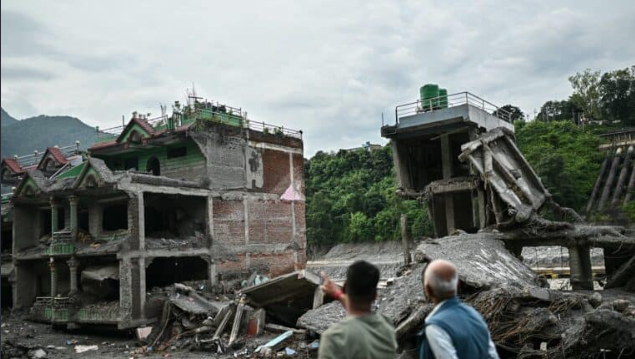
The scale of destruction was visible nearby, with damaged buildings, partially buried vehicles and large piles of mud covering areas affected by the floodwaters. Army helicopters continued to operate in the region as rescue efforts remained underway.
The August 26 disaster, triggered after a massive glacial mountain collapse along the China-Nepal border sent debris into a river, has killed more than 1,300 people and left more than 5,600 missing across Nepal and China, according to the report.
The United Nations appealed on Friday for $50 million in assistance for more than 84,000 people affected by the disaster in Nepal.
For Sumita Tamang, finding her missing husband remains her primary concern. The 33-year-old said she had received no information about him since the floods.
“I’ve looked for him everywhere, but I still have no news of him,” she said, expressing hope that he would eventually return.
“It’s been nine days.”
For some survivors, the destruction has been more severe than the damage caused by the powerful 2015 earthquake that struck the region.
Rawendra Dawadi, 47, headteacher of Trishuli Bazaar Secondary School, said the latest disaster had caused greater losses because the floods destroyed not only buildings but also the land on which they stood.
“This disaster is far worse,” Dawadi said.
He recalled that although his school had been destroyed in the 2015 earthquake, it could be rebuilt because the land remained available. “This time, we’ve lost the land as well as the building,” he said.
Dawadi said the school would need a new site before reconstruction could begin, adding that the affected area was no longer safe.
At Shree Chandrajyoti Secondary School, hundreds of displaced people from Nuwakot district have taken shelter and queue for hot meals.
Among them is 72-year-old Krishna Lal Chitrakar, whose home and the houses of his three sons in Devighat were swept away.
He said the area where his family had lived for generations had effectively become part of the riverbank.
“My father and four generations of my family lived in this spot,” Chitrakar said.
He is now staying with 11 relatives in a classroom, where families sleep on school benches with few possessions.
“We have lost everything,” he said. “But everyone is alive. Should I be happy or sad?”