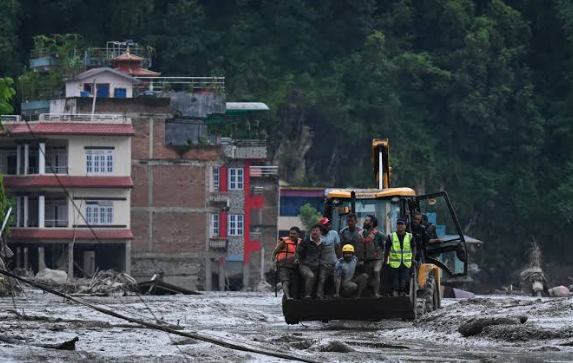
Rescue teams using helicopters have been evacuating survivors from valleys devastated by a powerful torrent of water and debris, believed to have been triggered by the collapse of a glacier.
More than 1,400 people remained missing on Friday, many of them foreign tourists, while the death toll had surpassed 550.
Sivaranjani Muthunathan, 46, was travelling by bus in Nepal with 56 other pilgrims from India’s Tamil Nadu state when their journey towards the Chinese border was halted. The group initially believed they were caught in a traffic jam.
She said the situation changed suddenly as fog and smoke surrounded the area before a huge surge of water and debris swept towards them. Several vehicles were washed away or buried under mud.
The passengers escaped through the driver’s side of the bus and climbed a nearby hill to safety, she said.
Another passenger, 53-year-old Vijayabhuvaneshwari, said the group had little choice but to flee after vehicles on both sides of their bus were swept away.
As they climbed to higher ground, she said, they could hear loud crashing sounds caused by rocks and boulders being carried by the floodwaters.
With elderly members of the group struggling to climb the slope, 61-year-old Poonguzhali Ponmambadan used her sari as an improvised rope. Her husband used it as a harness to help several older pilgrims reach safety.
Workers rescued from hydropower projects in Nepal’s Trishuli valley said the disaster struck within minutes.
Dev Shrestha, who was airlifted from a worksite, said around 400 workers were present when the flooding hit and believed the number of deaths exceeded those rescued.
Buddha Tamang said he survived because he was inside a tunnel when the flood struck. After spending more than 24 hours stranded, he was eventually rescued by helicopter.
He said several senior officials working outside the tunnel were swept away.
Another worker, Arjun Kumar Tamang, described extensive destruction at the hydropower facility, saying the force of the water swept away almost everything in its path.
Indian engineer Ananay Sharma, 29, said he was at a hydropower powerhouse when he heard a loud noise and was instructed to evacuate.
“When I came out, everything was gone; only the river remained,” he said, adding that one residential camp had been completely washed away while another remained standing and provided shelter.
Engineer Gorakh Khatka, who was near Shanti Bazar close to the disaster’s epicentre, said residents had only seconds to react before mud and water surged to around six metres.
He said he and others fled to higher ground and remained stranded on a hill for more than 48 hours before rescue teams arrived.