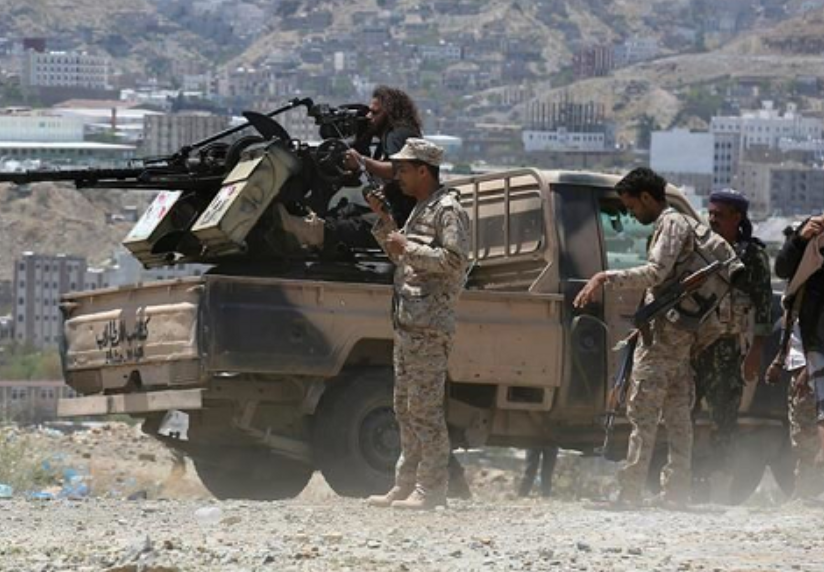
A Yemeni military source said 30 Houthi fighters were killed in clashes west of Taiz, as government forces intensified attacks on the group’s positions in several parts of the country.
The source, quoted by the Armed Forces Media Centre, said Yemeni warplanes also targeted Houthi vehicles and gathering points in the area where the clashes took place.
The army had earlier said its air force struck Houthi supply routes and deployment positions in Taiz and the Red Sea port city of Mocha.
Government forces also reported repelling previous Houthi attacks in Taiz and carrying out strikes against the group’s positions and reinforcements. Taiz has emerged as one of the main fronts as the army has increased attacks on Houthi positions in several provinces in recent days.
Italy is prepared to act independently to ensure the safe passage of its merchant vessels through the Bab el-Mandeb Strait rather than wait for an EU naval mission, Defence Minister Guido Crosetto said on Thursday.
Crosetto said he had instructed military officials to assess the security situation and prepare a plan to ensure safe passage through the strategic Red Sea waterway, according to Italian news agency ANSA.
“Together with the chief of General Staff, we have decided not to wait for (EU Red Sea Operation) Aspides to decide whether ships can pass or not,” he said at the Risorsa Mare Forum in La Spezia.
Crosetto said Italy could take measures to allow its vessels to resume transit without waiting for European procedures, warning that further delays could increase economic costs.
The Italian frigate Bergamini is currently deployed in Djibouti, while around a dozen Italian-flagged or Italian-owned merchant vessels are seeking escorted passage, ANSA reported.
Italian authorities are also examining whether existing regulations would allow military assets already deployed in the region to be temporarily placed under national command or whether additional parliamentary approval would be required.
“When a sea route is interrupted, goods arrive late, costs increase, and prices for families and businesses mount,” Crosetto said.
Iran said on Thursday that it had struck a Togo-flagged oil tanker in the Strait of Hormuz after the vessel allegedly attempted what Iranian authorities described as an “illegal passage”.
In a statement carried by the official IRNA news agency, the Islamic Revolutionary Guard Corps Navy said the tanker had been influenced by the US military before attempting to cross the strategic waterway overnight.
The IRGC Navy said the vessel, identified as the Trend, was struck and stopped after a fire broke out.
Iranian forces said they remained in control of the strategic waterway and would prevent what they described as hostile activity.
The IRGC Navy also warned shipowners and crews against attempting to cross the strait without permission.
There was no immediate independent verification of the reported strike, fire or the tanker’s condition. Iranian authorities did not provide details about the vessel’s cargo, crew, possible casualties or whether the tanker remained afloat. US military officials did not immediately comment.
Saudi Arabia and Yemen’s Houthis exchanged fresh strikes across their border on Thursday, while civilians fled parts of Yemen by boat as the conflict expanded and raised further concerns over regional oil supplies.
Houthi-controlled television reported Saudi airstrikes in Hajjah province near the Saudi border and along the Red Sea coast, as well as in the vicinity of Taiz farther south.
Saudi civil defence authorities said a Yemeni national living in Saudi Arabia was killed by debris from a drone intercepted over the western city of Taif. It was the first death reported by Riyadh from Houthi attacks since the latest escalation began. Saudi authorities have previously said more than 80 people were wounded.
Iran’s Revolutionary Guards Navy separately said the Togo-flagged tanker caught fire after being hit while attempting what it called an “illegal passage” through the Strait of Hormuz.
The expansion of the conflict into Yemen and Saudi Arabia has raised concerns about global energy supplies by putting the Red Sea route, an alternative corridor for Gulf oil exports, at greater risk while shipping through the Strait of Hormuz remains restricted.
US President Donald Trump has rejected Saudi requests for military assistance against the Houthis. The group reached a ceasefire agreement with Washington last year following a two-month US bombing campaign.
Trump said on Thursday that he was approaching a key decision on whether to resume large-scale attacks against Iran.
“I have a big decision coming up,” Trump said in an interview with Axios, referring to the possibility of further military action against Iran.
Global crude prices eased slightly on Thursday but remained above $100 a barrel after reaching their highest levels since May. The average US retail diesel price also reached a record high, approaching $6.40 per gallon.
The United States and Iran have not resumed negotiations to end the conflict since an interim agreement reached in June collapsed within weeks. The war is expected to be discussed at the United Nations General Assembly next week, with the US State Department saying an Iranian delegation will be allowed to attend.
The latest fighting has forced Yemeni civilians to flee across the Bab el-Mandeb Strait, which connects the Red Sea with the Gulf of Aden.
In Djibouti, on the African side of the Red Sea, 50-year-old Wahida Omer arrived after crossing from Yemen in a small boat when her village of Dhubab came under attack as Houthi forces advanced into the area.
Omer said her husband remained behind and that she did not know whether he was alive, dead or had been captured.
“The sea was frightening, difficult,” she said in an interview filmed by the International Organization for Migration (IOM). She said those aboard the boat cried throughout the journey and arrived without food.
The IOM said more than 100,000 Yemenis have been displaced by the latest fighting, most of them within Yemen.
The Houthis, who have advanced along Yemen’s Red Sea coast since last week, say Saudi aircraft have carried out hundreds of airstrikes in recent days. The group also claimed on Wednesday that it had shot down a Saudi F-15 fighter jet.
Houthi leader Abdul Malik al-Houthi said the group wanted Saudi Arabia to end what he described as a blockade and occupation of Yemen and halt military action against the Houthis.
Meanwhile, the US Navy has been seeking to guide commercial vessels through the Strait of Hormuz, a major global energy corridor along Iran’s southern coast. Before the conflict, the waterway carried about a fifth of global oil and liquefied natural gas supplies.
Iran has declared the strait closed and said it will remain so until Washington lifts its blockade. Tehran is also seeking an arrangement with neighbouring Gulf states that would allow it to collect fees from vessels transiting the waterway.