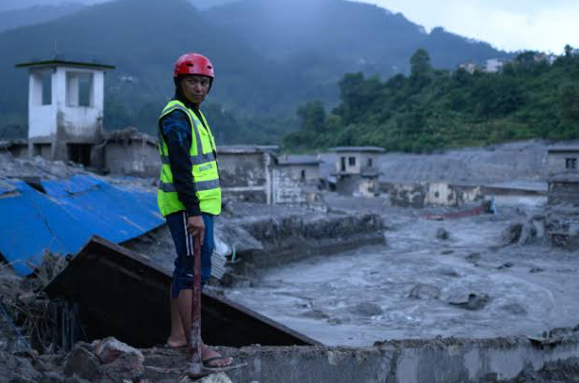
A glacier collapse in Nepal’s border region with China on August 26 triggered a massive surge of ice, rocks and mud, destroying settlements and villages and leaving thousands of homes either washed away or buried under debris.
Dharma Raj Upreti, chief of Nepal’s National Disaster Risk Reduction and Management Authority, said preliminary estimates showed that around 7,500 houses had been completely destroyed.
Many homes that remained standing were deemed unsafe for habitation, with authorities estimating that around 20,000 houses would need to be rebuilt at safer locations.
“We anticipate that the resources required for rebuilding will be substantial,” Foreign Minister Shisir Khanal told foreign ambassadors in Kathmandu.
At least 1,252 people were killed in Nepal after the disaster swept through towns and villages near the border with China’s Tibet. More than 4,200 people remain missing, while thousands of others have been displaced.
China has reported 21 deaths in Tibet, with another 541 people listed as missing.
Nepal’s cabinet has declared September 7, the 13th day after the disaster, as a national day of mourning. In Hindu tradition, the 13th day marks the conclusion of the formal mourning period.
More than 9,300 Nepali army personnel have been deployed across the affected areas, including Timure in Rasuwa, Nuwakot, Dhading, Chitwan and Nawalparasi East.
The troops are assisting with search and rescue operations, recovering bodies, clearing blocked roads and providing emergency medical care.
An Australian medical student whose partner went missing near the Nepal-China border has called on technology companies to share telecommunications and tracking data that could help rescue teams narrow their search areas.
Nepal said at least 583 foreign nationals were among those missing, including pilgrims and trekkers.
An army officer said search operations were continuing with experts from India, South Korea and China for at least 900 people believed to be trapped inside tunnels associated with hydropower projects.
Army spokesperson Raja Ram Basnet said two bodies had been recovered from a tunnel at the Langtang Khola hydropower plant.
Australia has pledged additional assistance and agreed to share telecommunications data with Nepali authorities.
China has also sent a third batch of emergency aid to Nepal, including tents, blankets, medical protective equipment and satellite communication gear. Beijing said its weather authorities were also coordinating with their Nepali counterparts.
Reports from Tibet on rescue operations have slowed after the G216 national highway leading to the affected area was reopened.
Nepal and China have linked the floods to climate change. Foreign Minister Khanal told diplomats that the disaster highlighted the wider risks posed by a warming Himalayas.
“Nepal contributes a negligible share of global emissions, yet our people bear a disproportionate burden of the impacts of a warming Himalayas,” he said.
Nepali authorities are also working to restore basic routines, with efforts focused on reopening schools and providing children with access to essential services.
UNICEF said more than a week after the disaster, at least 22,000 children urgently needed safe drinking water, sanitation and hygiene facilities.
“Our priority is to restore normal life,” said Phanindra Paudel, an official at Nepal’s National Emergency Operation Centre. He said authorities were considering holding classes at temporary centres.
Teachers said finding safe buildings for classrooms remained a major challenge.
Rajendra Dawadi, headmaster of a school that was completely destroyed, said the institution would have to be rebuilt at a safer location. He said timely evacuation had helped save around 900 students.
For survivors such as 45-year-old Shanti Sunar, returning home is no longer an option.
Sunar escaped with her husband but lost her home and small shop in the disaster. She said she had been visiting the site regularly but found no trace of her house.
“We cannot rebuild at the same location because it is not safe,” she said, expressing hope that the government would relocate affected families to safer areas.
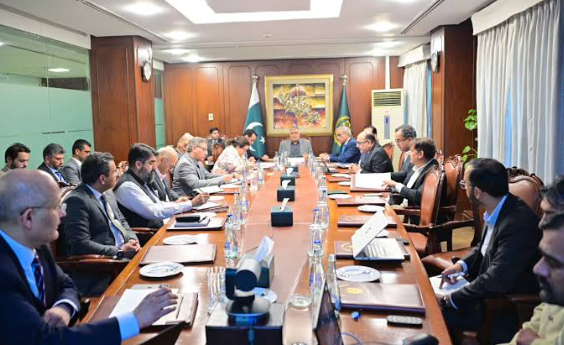
Meanwhile, Prime Minister Shehbaz Sharif assured Nepal’s Ambassador to Pakistan Rita Dhital of Pakistan’s continued assistance during a visit to the Nepalese Embassy in Islamabad, according to the Prime Minister’s Office.
The prime minister expressed condolences to the Nepalese government and people, as well as families who lost loved ones in the disaster.
The PMO said Pakistan would send emergency relief supplies to Nepal later in the week.
Shehbaz also reaffirmed Pakistan’s continued support for Nepal and expressed hope that the country’s people would recover and emerge stronger from the tragedy.