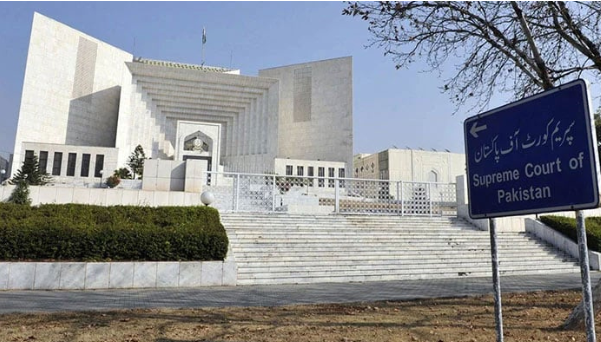
The Supreme Court has ruled that an accused person should not be denied bail when reasonable doubt exists regarding their alleged involvement in a crime, emphasising that the purpose of a criminal trial is to determine guilt rather than keep an under-trial suspect behind bars as a form of punishment.
The observation was made by Justice Muhammad Ali Mazhar in a five-page judgment issued on Wednesday. He was heading a three-member bench that heard a criminal appeal filed by Muhammad Akbar on July 22. The court had initially granted Akbar post-arrest bail on April 16 in a case registered at Quetta’s New Sariab Police Station.
The Supreme Court extended the bail on the same terms and conditions, clarifying that its observations were tentative and would not prejudice proceedings before the trial court.
“We are of the firm view that the case of the petitioner requires further inquiry,” Justice Mazhar stated in the judgment.
The court observed that whenever reasonable doubt arises about an accused person’s participation in an offence, the credibility of the prosecution’s case or the likelihood of the evidence supporting the charges, the accused should not be deprived of the benefit of bail.
In such circumstances, the judgment said, keeping the accused on bail during the trial was preferable to continuing their detention.
According to the judgment, the original case against Akbar was registered under Sections 379, 420, 274, 275 and 276 of the Pakistan Penal Code (PPC), along with Sections 23 and 27 of the Drugs Act 1976. The allegations concerned the transportation of expired medicines.
On April 16, a two-member Supreme Court bench granted Akbar post-arrest bail against surety bonds of Rs100,000, with two sureties in the same amount, subject to the satisfaction of the trial court.
However, when the bail order was sent to the relevant authorities for implementation, the court learned that the prosecution had amended the first information report (FIR). The original provisions were replaced with Sections 409, 471, 468, 467, 420 and 109 of the PPC, read with Section 5(2) of the Prevention of Corruption Act 1947.
These provisions relate to offences including criminal breach of trust, forgery, cheating and abetment, and carry substantially more severe penalties than the provisions originally invoked.
During the July hearing, the court questioned state counsel Baqir Shah and investigating officer Muhammad Ajmal about the reasons for introducing the additional charges.
They told the bench that the amendments had been made on January 15 but could not provide a satisfactory explanation for why the revised FIR had not been presented when the Supreme Court considered the bail application.
The officials also failed to explain why Sections 23 and 27 of the Drugs Act had been removed, despite the original allegation concerning the transportation of expired medicines in violation of the law.
When asked what new evidence had justified the changes, the investigating officer said four witness statements had been recorded under Section 161 of the Code of Criminal Procedure.
He further informed the court that the Quetta deputy superintendent of police responsible for prosecution had sought the opinion of the deputy inspector general (Legal), who recommended deleting the previous provisions and adding new ones.
Justice Mazhar expressed concern over the prosecution’s handling of the case, suggesting that the changes appeared to have complicated the proceedings without adequately explaining the legal basis for removing the original charges.
“It appears from the conduct of the prosecution that to complicate the case with some ulterior motives, the prosecution acted unfairly and added certain sections without realising the effect of deleting these sections of the Drugs Act,” the judge observed.
He added that the changes might also have been intended to frustrate the earlier bail order and deprive the petitioner of the relief granted by the court.
Although the judge refrained from making definitive adverse findings because the matter remained pending before the trial court, he said the possibility could not be ruled out that the additional charges had been introduced after the Supreme Court’s order to prevent Akbar from securing release.
Justice Mazhar stressed that new offences could be added during an investigation when supported by evidence, but not at the prosecution’s discretion without a proper factual basis.
“We are sanguine that new section/offence can be inserted, provided that something was gleaned to the prosecution on investigation of crime but not on the whims of prosecution,” the judgment stated.
The judge further remarked that the prosecution had not handled the matter seriously. If the additional charges had been introduced before bail was granted, he said, the development should have been brought to the Supreme Court’s attention for consideration rather than being withheld.
He regretted that, despite having secured bail from the apex court, Akbar remained behind bars because of what he described as the authorities’ careless handling of the case.
The judgment noted that the prosecution’s changing position, together with the addition and removal of different legal provisions in the same FIR, strengthened the grounds for treating the matter as one requiring further inquiry.
It said the prosecution appeared uncertain about the petitioner’s alleged culpability because of its shifting stance.
The court explained that the concept of further inquiry involves a tentative assessment of the available material, which may raise doubts about an accused person’s involvement in an alleged offence.
The Supreme Court consequently extended Akbar’s bail on the existing terms and conditions, while clarifying that the observations made in its order would not influence the final determination of the case by the trial court.